
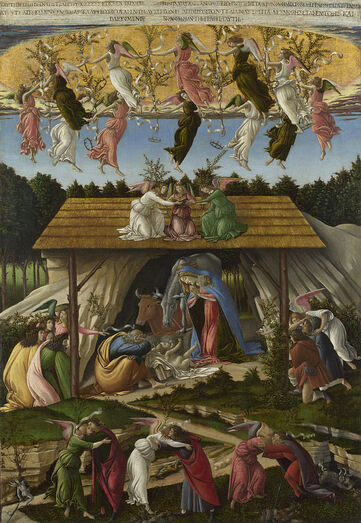
There are two tracks about following God that are highlighted in today’s readings. One is discernment, like the Wise Men, who live with clarity of vision and direction so that God can guide them by their knowledge of astronomy and comprehension of prophecy. The other is more about “following” from simple intuition, like the Shepherds, who live life in the open air, in nature, in awe and amazement at the revelation of God, with hearts that surrender to their own weakness.
The prophecies of Isaiah are prophecies for Isreal, the People of God, and, now, through Christ, they are prophecies for the Gentiles too. We are one body, all heirs to the Father “in one Spirit.” We can all have the same insight, now, given to us through the revelation of the Holy Spirit, as Paul says elsewhere in Ephesians (Ephesians 2:14-18 + Galatians 3:28-29). It may not be clear how this fits in with the reading from Isaiah.
Isaiah says to us, “Arise, shine, for your light has come!… lift up your eyes and look around! your daughters and your sons journey from afar, escorted in safety; you’ll see them and beam with joy, your heart will swell with pride!” Isaiah is saying that “you” are the light, luminous with God’s love; that the Glory of God is dawning upon “you” and will radiate through your heart. But who is the “you” when “darkness still covers the earth and dense clouds enshroud the peoples.” As I understand it, people have always been allowed to covert to following the Hebrew God, but until Christ came to Earth, this conversion necessitated following laws and commandments. Now, since Jesus abolished the law with its commandments and legal claims, it is a question of… faith… or at least, there is less clarity around what it actually is to follow God. What are the peoples and what are the nations now that we are all one, in the Holy Spirit? What is it that we are actually supposed to be doing? And are we doing it?
Are we one of those with a heart for God, God’s hands and feet on Earth, as Teresa of Avila says? Or are we one of those still in the darkness, shrouded with dense cloud?
What does it mean to be a prisoner for Christ, to be chained to the Spirit? (Ephesians 3:1, Philippians 1:13)
How do we live this human life, with all its twists and turns and maze of possibilities? How do we let God guide us? Should we find direction through discernment, or should we collapse in our own weakness and trust in God to pick us up and channel us through to righteousness?
We are commanded by Jesus to be “as shrewd as serpents and simple as doves” (Matthew 10:16) and by Paul to “Test everything; retain what is good” (1 Thessalonians 5:21), yet we are also told that weakness is where God’s Grace flourishes.
How to follow God, how to “get it right,” is a question that terrifies many Christians. The wrong paths that we chose cause us to be re-directed by God, torn to pieces, humiliated, judged, struck down, killed… (in the words of Hosea).
— Psalm 119 describes a treacherous terrain, with snares set for us, and our lives always at risk, and where “God’s word is a lamp for our feet.” I live by similar images myself — Jesus ahead of me, beating me a path through a jungle thicket with a machete, or laying stepping stones for me through marshland, knowing there will at least be one way through the confusion, even if I can’t see it; crying out to God in my anxiety or confusion when I feel I have fallen down or again become lost.
John Bunyan’s The Pilgrim’s Progress is also great for this imagery, as he describes the pitfalls of falling off the pilgrim’s path, and illustrates to us how we are tempted away from righteousness for all sorts of reasons. Without hindsight, it is not always clear which way is right. We find out by trial and error, making mistakes and realising too late the peril we have got ourselves into. What looked like a shortcut turns out to take us years off our path, and costs us years to get back. Hopefully, like Pilgrim, we can even find our way back.
When we get into hardship and confusion, and when we think we have been going in the right direction, then we reassess and aren’t so sure, when confusion reigns and we can’t find the path of the heart, we really feel the yearning for God’s commandments. If only we could, we would follow. But we can’t manage it, no matter how hard we try. We hit wall after wall, error after error. In these moments, terror can surely feel like it is surrounding us.
Psalm 23 describes God’s rod and staff as comforting (Psalm 23:4). God’s guidance is “punishing” insofar as it is shaping us up to be His people. “Therefore,” Paul says, “I am content with weaknesses, insults, hardships, persecutions, and constraints, for the sake of Christ; for when I am weak, then I am strong” (2 Corinthians 12:10).
So we are weak. So we are punished mercilessly when we stray off the path, and this merciless punishment is merciful because it directs us towards God, where we find our salvation.
What will it take to open our eyes?
Certainly our own hardship is a driving force, creating strong desire to discern a better path, to become allies in Christ, even out of our own selfishness and desire to live an easy life, once we realise that aligning with God brings joy, not hardship — whatever our circumstances.
Jesus came to Earth a human being. He lived a human life and there was nothing special about him. He winded his way, just the same as the rest of us. But he did it perfectly — even though there is no perfection. Jesus felt everything. He discerned everything. Jesus teaches us how to follow our hearts, the uniqueness of each of us on our own paths. He tells us that we can be as bold and confident as him, and find our strength in him. Jesus tells us, “follow me”. He promises us that we do know the way. He says, “You know the way to where I am going” (John 14:4), “I am the way.” (John 14:6). I think Jesus is saying, “follow me, just as I am the way, you are the way.” Jesus knows we struggle to go our way, and even promises us that he will come back for us and take us to the place he has prepared for us. We disciples say to Jesus again and again “we do not know the way!” and Jesus meets us exactly where we are.
And where are we? When Jesus, imploring us with his love, says, “from now on, you have known and seen the father” we say back to him, un-hearingly, “Master, show us the father, that’s all we’re asking for!” Just like the disciples, we are in a turmoil of confusion.
There is truth in the images of the pilgrim’s journey, the paths laid out for us by God; but I don’t feel it is everything. Where we go astray, it’s not by mistake exactly… it’s rather by necessity. Wouldn’t we follow if we could? If it wasn’t so impossibly difficult, for one reason or another? Didn’t Jesus look upon the rich man and the poor man alike with love and compassion?
Like the Prodigal Son, we have to go these ways, we can’t do anything else — with all our efforts and good will, we again and again find ourselves lost from the way. Even like the older son, caught in hypocrisy and resentment, what choice do we have? For each of us, the Father stands with arms open, with a heart that loves without condition, whichever path we take, whether we are staying or returning.
If we were tested by immediate outcome, to what extent could any of us say we live a life of discernment or of following our hearts…? But we are not being tested. Like Peter, we fall on our knees in humility when we see how we are loved by the innocent heart of Christ, how we have turned our backs on the abundance of his love, the sublime dawn of his glory, in order to cling to insignificant and toxic man-made “riches”.
It is choosing to pretend with the stone in our panic at the apparent absence of bread.
Of course the Good Father regards us like damaged offspring of damaged parents, delighting in any achievements in the direction of Life given the trauma of the conditions of our upbringing which drag so strongly towards Death. Even as God watches us pollute our personal relationships, our environments, our planet, our Solar System, with the trash of our traumatised lack of presence. Who could be more patient than God? Even while the consequences of our diversion from the Road to Life can’t be avoided. He joins us there in anguish.
Jesus says to us, “Go and learn the meaning of the words, ‘I desire mercy, not sacrifice’” (Matthew 9:13). Jesus is quoting God, from Hosea (6:6). There is no sacrifice which will pay the price, do the job for us, compensate for the sinfulness of our ways, for our mistakes. As Jesus definitively tells us, he has “come for sinners, not for the righteous” so we do not have to do anything else than be ourselves, follow our own desire and hunger for God’s promises, even when they lead us astray in our lack of comprehension. We live in reality, now.
There is no perfection for us, no rules to follow, not even any set path, only Christ, the way of truth and life, the way we have to live for ourselves. We have to find our own way. Away from the whitewashed fabrication of what we like to present. Into the places we fear to show ourselves. To present them to God’s Glory and find, when we do so, that we do not die, because all that is required of us is our own honesty, our own best efforts with all the integrity that we can muster. And it’s a journey in time. It doesn’t happen all at once.
Like Peter sinking into the water when he loses his faith, when he falls out of alignment with the commands of Jesus, all we can do is be in our failure, in our frailty, cry out to God and let God guide us back to life, back to the “unfathomable riches of the mystery of Christ”. This is truly how we live out the mystery of the incarnation. It is all already here, lift up your eyes and look around!
This Homily was presented on the 5th January 2025, at the Epiphany service, for the Orthodox Catholic Church of America (OCCA), St Mary Magdala Parish, Fort Wayne, USA
Based on the readings:ISAIAH 60:1-6“Arise, shine, for your light has come! the glory of YHWH is rising upon you! Though darkness still covers the earth and dense clouds enshroud the peoples, upon you YHWH now dawns, and God’s glory will be seen among you! The nations will come to your light and the leaders to your bright dawn! Lift up your eyes, and look around: they’re all gathering and coming to you—your daughters and your sons joxfurney from afar, escorted in safety; you’ll see them and beam with joy, your heart will swell with pride. The riches of the sea will flow to you, and the wealth of the nations will come to you—camel caravans will cover your roads, the dromedaries of Midian and Ephah; everyone in Sheba will come, bringing gold and incense and singing the praise of YHWH.
The Word of the Lord.
Thanks be to God.Psalm 72
Endow the king with your justice, O God, the royal son with your righteousness. May he judge your people in righteousness, your afflicted ones with justice.
May the mountains bring prosperity to the people, the hills the fruit of righteousness.
May he defend the afflicted among the people and save the children of the needy; may he crush the oppressor.
May he endure as long as the sun, as long as the moon, through all generations.
May he be like rain falling on a mown field, like showers watering the earth.
In his days may the righteous flourish and prosperity abound till the moon is no more.
May he rule from sea to sea and from the River to the ends of the earth.
May the desert tribes bow before him and his enemies lick the dust.
May the kings of Tarshish and of distant shores bring tribute to him. May the kings of Sheba and Seba present him gifts.
May all kings bow down to him and all nations serve him.
For he will deliver the needy who cry out, the afflicted who have no one to help.
He will take pity on the weak and the needy and save the needy from death.
He will rescue them from oppression and violence, for precious is their blood in his sight.
Long may he live! May gold from Sheba be given him. May people ever pray for him and bless him all day long.
May grain abound throughout the land; on the tops of the hills may it sway. May the crops flourish like Lebanon and thrive like the grass of the field.
May his name endure forever; may it continue as long as the sun. Then all nations will be blessed through him, and they will call him blessed.
Praise be to the Lord God, the God of Israel, who alone does marvellous deeds.
Praise be to his glorious name forever; may the whole earth be filled with his glory.
Amen and Amen.
EPHESIANS 3:1-12 For I, Paul—a prisoner of Christ Jesus for the sake of you Gentiles—am sure that you have heard of God’s grace, of which I was made a steward on your behalf; this mystery, as I have briefly described it, was given to me by revelation. When you read this, you can understand my insight into the mystery of Christ, which was unknown to the people of former ages, but is now revealed by the Spirit to the holy apostles and prophets. That mystery is that the Gentiles are heirs, as are we; members of the Body, as are we; and partakers of the promise of Jesus the Messiah through the Good News, as are we.
I became a minister of the Good News by the gift of divine grace given me through the working of God’s power. To me, the least of all believers, was given the grace to preach to the Gentiles the unfathomable riches of Christ and to enlighten all people on the mysterious design which for ages was hidden in God, the Creator of all. Now, therefore, through the church, God’s manifold wisdom is made known to the rulers and powers of heaven, in accord with the age-old design, carried out in Christ Jesus our Savior, in whom we have boldness and confident access to God through our faith in Christ.
The Word of the Lord.
Thanks be to God.MATTHEW 2:1-12After Jesus’ birth—which happened in Bethlehem of Judea, during the reign of Herod—astrologers from the East arrived in Jerusalem and asked, “Where is the newborn ruler of the Jews? We observed his star at its rising and have come to pay homage.” At this news Herod became greatly disturbed, as did all of Jerusalem. Summoning all the chief priests and religious scholars of the people, he asked them where the Messiah was to be born. “In Bethlehem of Judea,” they informed him. “Here is what the prophet has written: ‘And you, Bethlehem, land of Judah, are by no means least among the leaders of Judah, since from you will come a ruler who is to shepherd my people Israel.’ ” Herod called the astrologers aside and found out from them the exact time of the star’s appearance. Then he sent them to Bethlehem, after having instructed them, “Go and get detailed information about the child. When you have found him, report back to me—so that I may go and offer homage, too.” After their audience with the ruler, they set out. The star which they had observed at its rising went ahead of them until it came to a standstill over the place where the child lay. They were overjoyed at seeing the star and, upon entering the house, found the child with Mary, his mother. They prostrated themselves and paid homage. Then they opened their coffers and presented the child with gifts of gold, frankincense and myrrh. They were warned in a dream not to return to Herod, so they went back to their own country by another route.
The Gospel of the Lord.
Praise to You, Lord, Jesus Christ!