
Following the recent Carmelite Spirituality Network workshop on Autism and Spiritual Direction, I wanted to share a picture of autism from the inside from a Carmelite perspective.
First a word from an autistic perspective on education and raising-awareness activism. Autism is all about encountering the world in a way that is authentic, raw and real. There is an image of autistic people being blunt and forthright. The reality is, we lack an ability to move easily in the ways and mores of the world — things others somehow pick up and take for granted. This means we lack pretensions and struggle to present ourselves because our culture seems to behave in a way that is inauthentic or even duplicitous. We struggle to such an extent that autism is registered as a disability. Unsuccessful attempts at communicating with the world can make us feel exhausted, and attempts to “include” us can leave us feeling even more isolated and excluded than we started off, because our reality isn’t being seen or met, though we are told that it is. Encountering the world can feel like facing a conspiracy of silence, an invisible barrier that keeps us at a distance. Perhaps this barrier-ed way of living is normal in the non-autistic world, but it is not normal for autistic people. We can look out and say, “you think we are the ones with the disability?” And often times, we will accept the role of “vulnerable one” just for the sake of keeping the peace, in an unstable dynamic.
So whilst being glad to see that energy is being directed towards education and inclusion, both for the sake of autistic people, and all marginalised peoples, it has to be said that, as with all activism, our actions must come from the heart if they are to make real progress. That is to say, if a place of true love, understanding, and empathy is not reached, what is produced is — ultimately — no more than the clanging of hollow brass. Though I speak with the tongue of angels, If I have not love, I am become as hollow brass.
Though I have the gift of prophecy, And understand all mysteries And all knowledge…
Though I have enough faith to move the mightiest mountains,
If I have not love,
I am nothing.
Though I am generous and give away all I own to feed the poor,
And give my body to be burned as a martyr, If I have not love, I would gain nothing.
Love is patient, Love is kind, It bears all things, It hopes all things.
Love never fails.
For prophecies shall fail, Tongues shall cease, Knowledge shall wither away.
For now we see but a faint Reflection of riddles and mysteries As though reflected in a mirror,
But one day we will see face to face.
And now shall abide… Faith, hope, and love. But the greatest of these three is love.
(1 Corinthians 13)
Autism needs to be met with love and reverence, and that is all it needs to be met with. Without Love, there is always a danger of activism being nothing more than status-quo-entrenching “pastoral power” power play, with the best of intentions, “more of the same”. When the Good Samaritan stops for the victim of attack, it is the Good Samaritan who is blessed as much as the victim, because, through stopping and genuinely opening his heart to the stranger’s needs, he touches the unknown, and, in sacred communion, receives something new.
“From the inside, it can sometimes be difficult for churches to see the power and privilege at work in their midst, when they are human social communities, as much as they are also the Body of Christ. Wisdom from beyond the church walls can amplify voices that have often gone unheard in Christian communities.” (At The Gates — Disability, Justice and the Churches, Naomi Lawson Jacobs and Emily Richardson, p. 29)
We can learn a lesson from Mary and Martha. The lesson is something along the lines of, “less effort, more heart.’ Or, “less of me, more of Him.” (John 3:30) Because of Christ’s words, our joy is complete to overflowing! (John 3:29) With His words, Christ only calls us to Love — not to inactivity, not to action, but to Love. We stop, and we listen, and His dynamic words lead us on the way.
“Mary sat down attentively before the Master, absorbing every revelation he shared. But Martha became exasperated with finishing the numerous household chores so she interrupted Jesus and said, “Lord, don’t you think it’s unfair that my sister left me to do all the work by myself? You should tell her to get up and help me!” The Lord answered her, “Martha, my beloved Martha. Why are you upset and troubled, pulled away by these many distractions? Mary has discovered the one thing most important by choosing to sit at my feet. She is undistracted, and I won’t take this privilege from her.” (Luke 10 39-42)
Whatever we do, we must only do it with Love. To truly understand that, it takes a depth of surrender, at the feet of Christ, and it is only His words which can take us there. It is wonderful to know, once we are there, that Jesus will not take this privilege away from us.
This article comes with an invitation: to listen at the feet of Christ. It is with Love that you will understand the autistic heart, with just the same Love that you will understand the heart of any of us.
My Personal Journey
The word “autism” came into my life about 13 years ago, with the diagnosis of a friend, and it stimulated a process of awakening in me: I grew in self-knowledge, in self-acceptance, in self-love. On this journey, I became capable of Love: Agape Love, if I hadn’t been before. This journey transformed me.
At the time of John’s (name changed for privacy) diagnosis, in learning to receive my friend in his autism, I became aware that I had a barrier towards everything that was “autistic” in me. This realisation hit me full in the face and took some processing. The word “autistic” had effectively been used in my vocabulary as an unintended insult. It was a way of dehumanising, excluding, and disowning a group of “other” people, and the “other” in myself. What I faced with John’s autism was the amount of hate and rejection I felt towards myself. Because I loved John so much, I could no longer externalise the hatred of what I could now label “autism.” The love I felt for John was for him completely, the whole person, and that meant what I embraced included the autism. Through that move — through Love alone — I learnt to love the autism in myself: because how could I love something in someone else but not love the same thing in myself? My love for John pushed me over the edge into inevitable love for myself. I had no choice. The autism was my barrier to self-love, and I let it go.
By observing my response to “autism”, I realised that what had been unwelcome in myself was not just “autism” but my whole self. I was experiencing the self-inflicted de-humanisation of my whole self. What is true on the micro level is true on the macro level: when we de-humanise a single other person in this world, and fail to be the Good Samaritan to them, it is not just that person who is excluded, it is the entirety of Creation.
Through loving John, through facing what I hated most in myself, I broke free of this hateful way of viewing autism, and in the process, I was forced (or given the Grace) to drop barriers to my heart that had, as a mechanism of survival, built up over my entire life. Parts of myself that were extremely unwelcome in this world needed to be protected, somehow, and the barriers were my attempts to protect myself.
Of course, as Christians, we know that barriers to the heart are barriers to God’s Love. What’s more, barriers to the heart offer no real protection. We throw up barriers, and they give us the appearance of safety but we are like Adam and Eve, attempting to hide our “nakedness” from God by hiding in the bushes of the Garden of Eden. We need to realise, with thankfulness, that there is no hiding from God, no safety apart from God, and no escaping our vulnerability apart from God.
As my heart opened to receive John, it also opened to receive God. I was converted from lukewarm Christian to a foundational conviction, with total surrender. Christ needed me to drop my barriers and let Him in, and this had meant, first: drop my barriers and let in the world. Jesus has no boundaries, only those imposed on Him by His Father in Heaven. As my barriers melted away, I surrendered to Love.
It is the fascist in ourselves which reacts with judgement to autism: are we “in” or are we “out”? What is “appropriate?” What is “worthy”? What isn’t? The truth is, who are we to say? Martha tries to tell Jesus what is right and proper, but Jesus dismisses her and refuses to be diverted from his heart of love for her and her sister.
Loving myself has meant loving the rejected parts, the parts I really hated, the parts I felt caused me so many problems throughout my life, those parts standing forlornly like little forest creatures in the edges of the glade of my consciousness, hiding behind the trees of my shadow self, only waiting for me to love and receive them, so they could emerge safely and be embraced by me! Bruised, fragile, shaking, cold, creeping and crippled little creatures, famished, ugly, unwanted, pushed away and rejected again and again… I finally managed to widen my heart enough to include all of them, broken and needy, and any more besides, including the whole world, because, once there, Jesus would not take the privilege away from me, and I wasn’t about to walk away.
The journey I went on is no different to the journey to self-love that any of us are commanded to go on, as Christians. Loving ourselves entails facing our reality, and being able to stand in it, without shame, because when we face ourselves, we face Christ, as much as we face Christ in everyone we meet. “Whoever is ashamed of me and of my words, the Son of Man will be ashamed of when he comes in his glory and in the glory of the Father and of the holy angels” (Luke 9:26). That isn’t a threat from Jesus, it’s just how it is.
Love
Meeting autistic children and their families, as I have done many times over the last 13 years since John’s diagnosis, I noticed how full-hearted they are. I heard from their families how their autistic child was tortured by seeing the harsh way other children treated each other and nature: violence, abuse, hate, vindictiveness, persecution. Autistic children can’t thrive when there is bullying of other children in the classroom, especially by, or overlooked by, teachers. Autistic children see deeply into the truth of encounters, and don’t see the masks or veneers. That’s one reason why Autistic people find it so difficult to fit in. We don’t have eyes for the social mores; and if we can see them, they feel like artifice which needs to be rejected. When teachers pick on certain children repeatedly, it is unbearable for an autistic child. The child sees the patterns, and finds themselves being the sole witness (and the soul witness) to the truth. Being autistic is like being the child who sees that the emperor is wearing no clothes. The autistic child feels the pain of what they see so deeply. The feeling is so deep it can’t find expression amongst the other children, or even amongst the teachers. Even in their own homes, their feelings might not be seen or understood, and in their church it is the same. There’s simply no place for all that deep thinking and feeling. This continues into adulthood, though people find strategies to cope and it becomes less visible.
When we hear about the autistic “sense of justice”, seen with such clarity with children, what it really means to the autistic child is that they are facing a deep, inexpressible feeling: the depth of unacknowledged truth; the depth of camaraderie, togetherness and fellow feeling; the discord between what they know to be true, and how heavily this is stamped down upon by the world around them… in the “sense of justice” the child becomes withdrawn and is left holding their wounds, wounded from feeling all these things and no-one else around them feeling or expressing the same things, or even being able to understand. Often, the child will be ridiculed and humiliated for their witness.
The pain is phenomenal, and all the child can do is carry it. Isn’t this what we call carrying our Cross?
The “sense of justice” feels very different from the inside to how it is portrayed by those looking from outside. Outsiders see what is a laughable cartoon. This continues into adulthood.
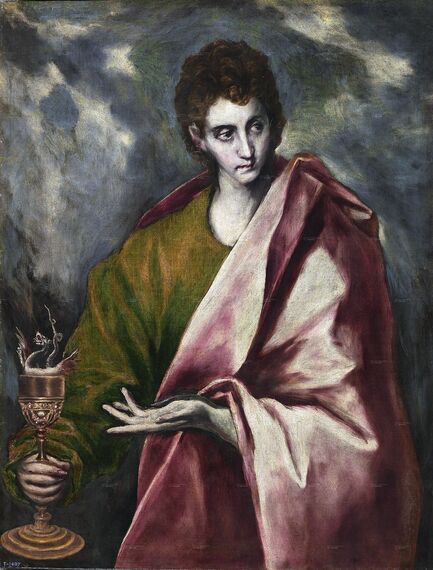
To be autistic… El Greco’s painting of St John the Evangelist comes to mind. This picture speaks to me of what it is to be alive, over a long period of time, and to feel everything. It speaks of how it feels when the depth of that situation just continues Having seen his friends martyred, having seen attempts on his own life fail (the transformed poisoned chalice that St John holds), and having not been martyred himself, but finding himself only continuing to live, on this earth, and bear witness… The deathly pallor, the storm clouds, the inner knowledge of glory that isn’t realised by others, the tired and sad eyes, the silent communication that doesn’t hope for understanding… For me, that is a picture of what it feels like to be autistic.
To carry that Cross takes strength and Love — and where does the autistic child get that strength and love from, if not from their family, church, and wider community? A child can be so locked in themselves, trapped by bullying and hate, terror all around them, that the pressure of it all can no longer be contained, and yet, where can it go? And how does this grow into adulthood?
Thérèse of Lisieux
Thérèse describes herself as a child standing on the edge of the playground looking in, observing, witnessing and not being able to participate. That’s all very familiar.
Thérèse describes her attempts at friendship, and her inner knowing that God can’t grant her any intimacy because there is no-one who can meet her where her heart is, except our Lord Jesus. “But alas! how narrow and flighty are the hearts of creatures!” (The Story of a Soul, St Terese of Lisieux, ICS Study Edition, p127, Chapter IV). Thérèse lost her parent at a young age, and that can make someone particularly soulful and unable to “join in” any more, but it’s more than this. The agony of bearing witness seems to be in Thérèse’s nature.
Thérèse was so careful in her childhood to behave as her family wanted her to behave: being the “cute youngest child”. It is clear to me, as an autistic reader, that the “cute” was a role Thérèse put on to please those around her, and co-habit peacefully. The “Christmas Conversion” happened because Thérèse realised that her family were actually completely fickle, and it wasn’t so easy to please them as she had realised. What? Suddenly her father had had enough of her being the delightful little one? But didn’t he know she did it only because she thought it bought him pleasure…? That she did it out of love for him…? Thérèse got a sudden lesson from her elders that they had only wanted her to continue in that pose until she was “old enough” to drop it. But how was she supposed to know that time had come?! Thérèse can’t understand the social mores, the rules that seem to govern everyone else, unconsciously. That is her blessing. I can feel her shock from the realisation that she got it wrong… the jarring into reality, into the insecurity of the reality, where the heart of ourself isn’t enough to bring Union.
We may all learn the same lesson, at some point, about the world in general — just as Jesus taught us that we could turn on even the most beautiful, most loving, most innocent human being ever to present itself to Earth, and, instead of cheering, start taunting and jeering at him as he walked, beaten, to the Cross and was hung up there, to die. Jesus lives this desolation for us all, the injustice, the discord, the impossibility of Union, the devastation of separation. And he takes it to the ultimate conclusion, transcending even the insult of death, because nothing is impossible with God.
Thérèse, in her death, has been taken up by the world that sees only her image, and excludes her reality. If Thérèse was really seen, would she still be loved? Really? We need to ask the same question of ourselves about Christ. Autistic people ask themselves this question every day, with each new person they meet, and know the answer. We see the reality.
What do we do with people who don’t fit in, and appear to be “less than human”, or even more than human? It’s even normal that our “empathy” goes no further than our prejudice’s leave us room for. We set a precedent when we excluded Jesus and said his death was for the greater good, and now our job, as a church, is not to maintain those exclusive structures, but its job is to realise exactly what the exclusion of Jesus means, both as lesson and Divine Grace, and find our way home to true empathy and relationship, where we truly meet each person with reverence and love.
Written by: Ruthie Baigent 08 Feb 2023
This article was originally published in the Synergy Journal 15 Oct 2023