
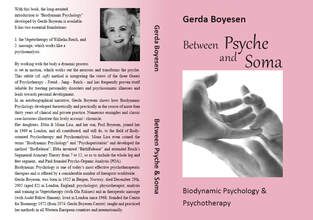
Gerda Boyesen, founder of Biodynamic Psychotherapy, trained first as a clinical psychologist, then, following a talk byDr Trygve Braatöy* discussingpsychotherapeutic work on the body, was inspired to train as**a physiotherapist. Gerda went on to take a work placement with Aadel Bülow Hansen. Alongside Gerda’s training, she was having therapy with Ola Raknes, a psychoanalyst in the Reichian tradition. Gerda integrated psychological ideas into the physiotherapy massage techniques she was learning, and Biodynamic Psychotherapy was born.*
Gerda came from an affluent and disciplined family, and was a “well behaved” child whose spirit was broken by the circumstances of her family life and upbringing. Gerda had developed a rigid character structure in her body. She went on to marry an “authoritarian” man (Carl Christian Boyesen), and have three children, Ebba, Mona Lisa, and Paul, all of whom continue in her work. As Gerda learned about new techniques in therapy, her own “rigidity” created a kind of baseline to work from, a starting point from which Gerda could compare and contrast the effectiveness of her therapeutic techniques.
The biodynamic therapy that Gerda developed was based on the Reichian theory that energy attracts fluid. Blood and bioenergy distends tissues, and this distention can be discharged with massage to release the “metabolic residues” that accumulate at the level of blood circulatory system due to incomplete vasomotoric cycles. This was a “discharge” which Bülow Hansen realised helped patients complete emotional cycles that had been interrupted by difficult circumstances in their lives.
Gerda took things a stage further by developing psychological theories around this process, for a wider application. It was a direction Bülow Hansen had not taken, preferring to work with individual patients on a more physical level, and psychological issues being taken to the psychiatrist Trygve Braatøy.
Gerda’s position as a physiotherapist coupled with her education as a psychologist gave her confidence to take the physiotherapy a step further. Remembering the words of Sigmund Freud: “It is best to work on the part of the unconscious that is closest to the ego”, Gerda sought a physical equivalent, a way to connect to the body that was closest to the ego (p76), to meet the patient’s unconscious in a way that was safe and effective, and gentle enough not to be overwhelming. In fact, Gerda went out of her way to connect these physiological and psychological worlds with a holistic, spiritual approach.
Working this way, Gerda discovered that she could relieve her patients of “inner pressure” and anxiety, and resolve issues of repression, conflict and emotional suppression. Gerda witnessed the effect of her approach as being “a kind of ‘manual psychoanalysis’ ” (p77).
This led to the discovery of psychoperistalsis as Gerda noticed peristaltic sounds of patients accompanying the work that she was doing. Gerda learned that by following the peristaltic sounds, she could control the potency and effectiveness of her treatments, managing a “gentle form of downward discharge” through the anal system (as opposed to through oral expression) (p78).
Gerda stated that when repression is pre-psyche, the work is not psychodynamic, it is biodynamic, and a pre-psyche “scream” that cannot be expressed through the oral system can be expressed through the anal system (the digestive system), with biodynamic work (p81-2).
Gerda’s theories expanded to seeing the body’s energy as going “in and out”, as well as “up and down” (through the oral and anal systems): “My experience had taught me that cosmic energy not only ascended and descended, but also moved towards the interior and towards the exterior” (p86-7).
Further clarity emerged when Gerda met an (unnamed) French doctor who helped her see that the “esoteric function of the intestines” was the digestion of stress (p93).
Gerda likened her discovery to that of Fleming discovering penicillin. She foresaw the healing biodynamic work could bring to millions. Gerda was a trail blazer caught between the “clinical and experimental branches of psychology”. Neither world accepted Gerda (p83). Gerda’s power was that she was holding this non-dual space between these two entirely “separate” worlds.
Gerda developed her understanding of peristalsis when she noticed her patients were improving most if their therapy sessions took place at quiet times of the day. Gerda realised that the noise of traffic had prevented her from hearing the peristaltic sounds of her patients’ digestion, which, Gerda became aware, had been guiding her treatments. Gerda’s decided to use a stethoscope to amplify the sound of the peristalsis.
With the stethoscope, Gerda started to explore the mystery of “the ocean within”, using the stethoscope on herself. Gerda noticed how the peristaltic noises changed with her changing thoughts, feelings and movements. Gerda noticed that the aliveness of this “ocean within” only arose when she was relaxed and free of obligation (p90).
For me, the strength of Gerda’s work is that she saw past the status quo, even where it was already pushing the boundaries of conventional thinking. She took even the radical theories of Reich and pushed them further, to their logical conclusion.
Gerda experimented with herself, listening within in a fearless way, and watching her own transformation. This informed Gerda’s development as a therapist, and also informed her approach towards self-regulation, which she practiced initially on herself.
Gerda “opened her heart to universal love and suffering” (p108) and approached her work with herself, her children and her patients as working on sacred ground:
“The therapist’s job is simply to offer total love and acceptance so that the patient’s ‘impulse-from-within’ can develop fully and transform his whole being. Massage is the very best way for the therapist to discover the love that lies within himself; in fact it is quite impossible to give a massage without love. The atmosphere that develops is the most important factor of all in therapy: the therapist’s empathy, tolerance and understanding create this atmosphere” (p111).
One criticism or caution I have with biodynamic work, as with other therapeutic work, is to ask, “is this work possibly too influential in the systems of human beings, too directive, having too much of a pre-existing idea about what stasis and self-regulation might look like for the client?” In my reading of Psyche and Soma, I feel Gerda is pulled in both directions — towards an approach of sacred love, and towards an approach which has more judgement and determinism involved. But then, she did say she was straddling both of these “opposing” worlds…
By Ruthie Baigent, February 2025